Your brain may store language as flat chunks, not just grammar trees
A Cornell–Aarhus study finds people store flat word chunks like "can I have a" alongside grammar trees, challenging a 70-year-old core assumption.
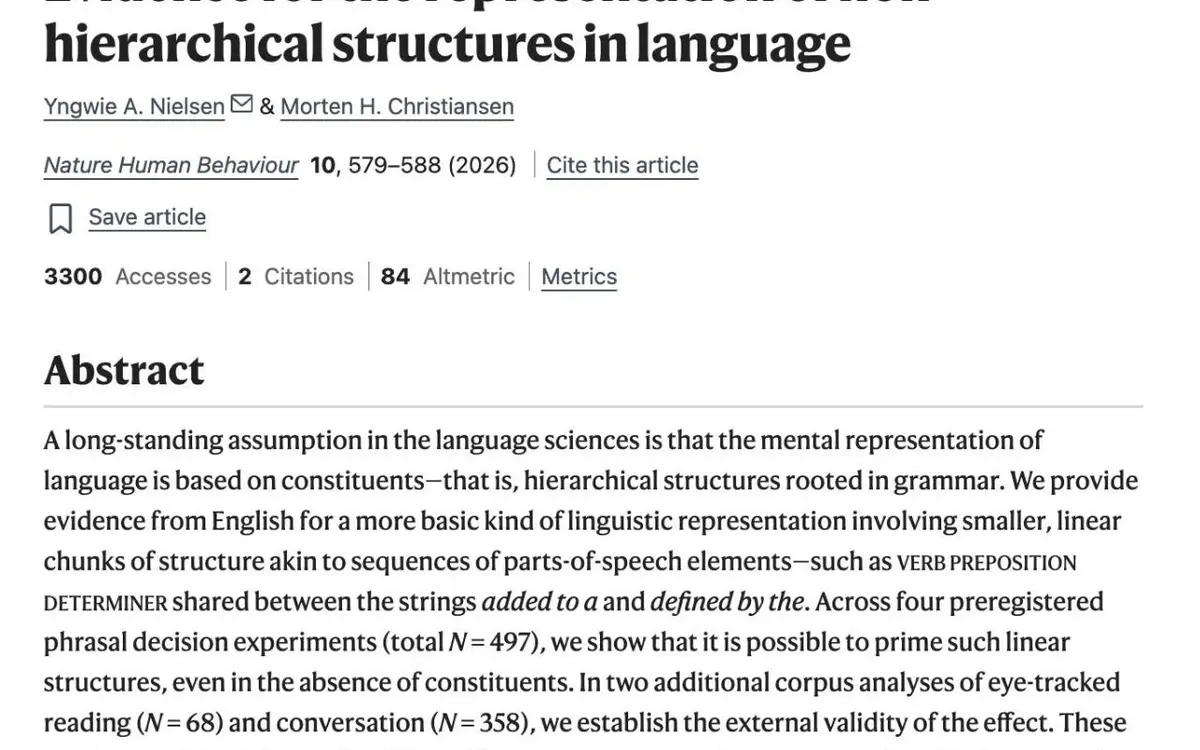
Linguists have long said that sentences live in your head as hierarchical trees: nested phrases built by abstract syntax rules. That idea has dominated since Chomsky's work in the 1950s. A study in Nature Human Behaviour by Morten Christiansen (Cornell) and Yngwie Nielsen (Aarhus) argues the trees aren't the whole story.
The pair ran experiments, including eye-tracking, and analysed real phone conversations. They found that flat, linear sequences of word classes get primed: people process them faster the second time. That includes strings no grammar tree treats as a unit, such as "can I have a" or "in the middle of the". Priming is a classic sign that the brain has stored something as a unit. So these "beads on a string" chunks seem to be part of how language is represented, working alongside grammatical structure.
The headline claims going around are louder than the paper. It doesn't say Chomsky was "proven wrong" or that hierarchy doesn't exist. Its claim is that tree-based grammar "cannot capture all" of our mental language structure. The study only covers English. Christiansen adds that if language needs less hierarchy than assumed, the gap between human language and animal communication may be smaller than we thought.
Why it matters: chunk-and-sequence processing looks a lot like how LLMs model text, which reopens the debate over whether next-token prediction is really so unlike human language.
Sources
Primary: the company, paper or repository
- Evidence for the representation of non-hierarchical structures in language (Nature Human Behaviour) nature.com
Independent coverage
- Discovery challenges assumptions about the structure of language news.cornell.edu
- Language may not be so hierarchical after all: A new study challenges 70 years of linguistic theory linguisticdiscovery.substack.com
Written by an AI pipeline from the sources above. Methodology · Report an error
The stories that matter for people who build with AI, with the source for every claim. Free, no spam.
Feed, daily deep-dive and bytes — readable offline, with push alerts for the topics you follow.