Google's first orbital AI chip woke up and wrote a haiku
Google's Suncatcher prototype ran Gemma 4 on a TPU in orbit, but power limits it to one chip for about 20 minutes.
Chips, infrastructure and compute. 30 stories, page 1 of 3.
Modern AI runs on specialised hardware and enormous infrastructure: GPUs and custom accelerators, memory bandwidth, data centres, power, and the software that makes them efficient. Chip and infrastructure news often explains which models can exist and what they cost to run.
This section covers silicon launches, supply and export developments, inference and training efficiency, and the economics of compute.
Google's Suncatcher prototype ran Gemma 4 on a TPU in orbit, but power limits it to one chip for about 20 minutes.
Google's Suncatcher prototype ran Gemma 4 in orbit and sent back a haiku. It's a chip test, not a working space data center.
Project Suncatcher's prototype ran Gemma 4 in orbit and sent back a poem, Google's first AI reply from a data-center chip in space.
XBOW used OpenAI's public GPT-5.6 Sol to chain three Chrome zero-days into a full exploit for about $40K in compute. Google paid its top bounty.
The Surface Laptop Ultra starts at $2,599 and the RTX Spark Dev Box costs $5,999. Both are built to run 120B-parameter models on the machine.
Ghidra and IDA now have MCP integrations, so AI agents can reverse-engineer a game binary. Rebuilding it is still real work.
The US Energy Department's Genesis Q contest pays teams to build a fault-tolerant quantum computer with 100+ logical qubits, possibly by 2028.
Huawei revealed its Atlas 960 SuperPoD and Ascend 960 roadmap, a year after its last cluster. China's AI chip gap keeps closing.
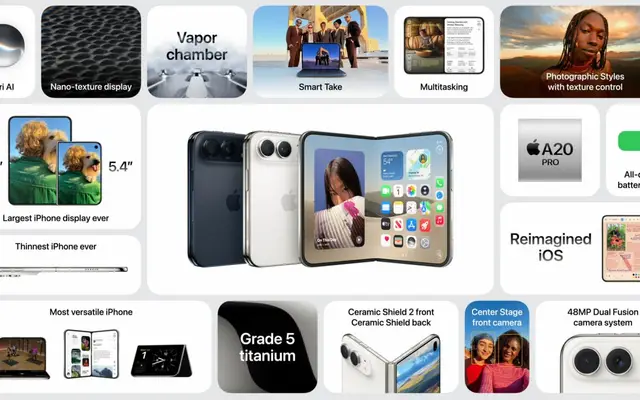
The $1,999 iPhone Duo ships the A20 Pro — first 2nm phone chip, 32 Neural Engine cores, 2x faster FP8 for on-device LLMs.
DeepSeek is buying $2.6B of Huawei silicon for a 1GW Inner Mongolia site — and still won't train on any of it.
Nvidia's Groq 3 LPX is in full production: 3,400 tokens/sec on 100K-context runs, 4x the nearest rival. Nebius takes it first.
A viral forecast puts AI power demand at 315 GW by 2033. Gartner's number for every data center on Earth in 2030 is 291 GW.