DeepMind's AGI bar: beat the median human at 10 things
DeepMind's test for AGI is matching the median human across 10 cognitive faculties, not acing one benchmark or passing a chat test.
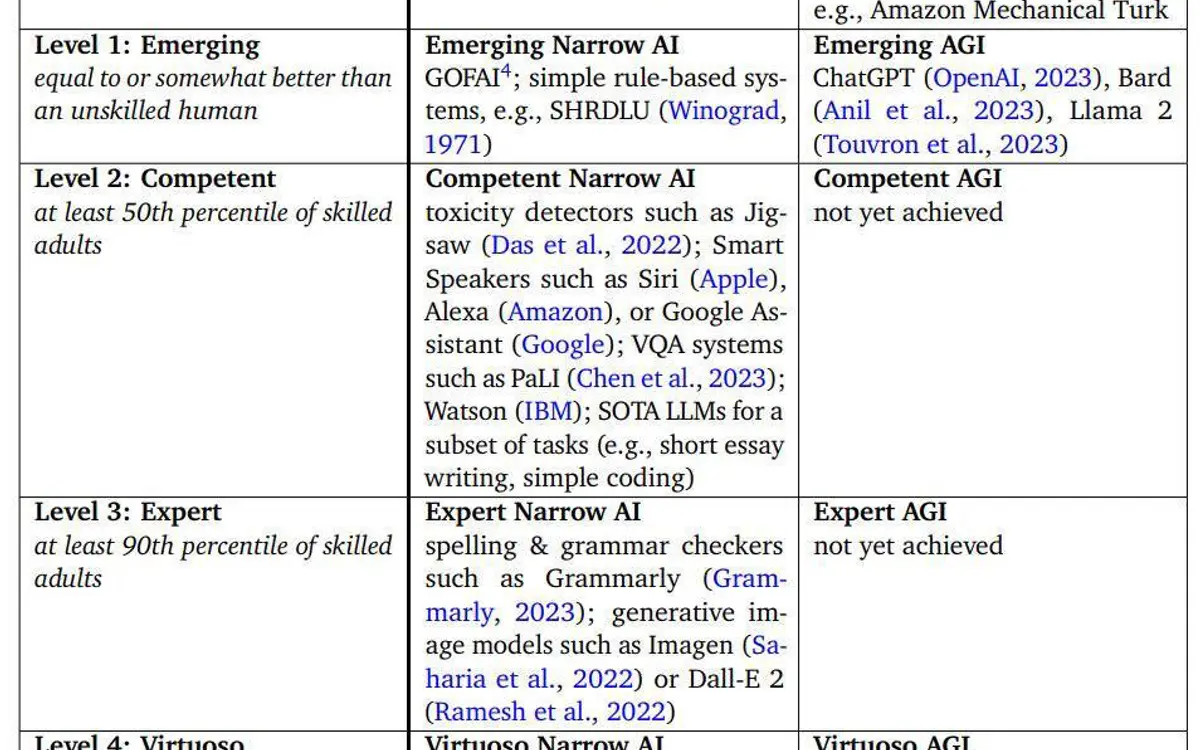
Google DeepMind's working definition of AGI is less exciting than the hype and a lot easier to test. In its March 2026 cognitive framework, an AI counts as AGI only if it at least matches median human performance across 10 faculties: perception, generation, attention, learning, memory, reasoning, metacognition, executive functions, problem solving and social cognition. Scores are measured against demographically representative adult baselines. Being brilliant at one of them doesn't count. You need all ten.
This builds on DeepMind's 2023 Levels of AGI paper, which scores depth and breadth separately. It runs from Emerging to Competent (beats 50% of skilled adults on a wide range of non-physical tasks), Expert, Virtuoso and Superhuman (beats 100% of them). By that yardstick today's chatbots are general but still low on the ladder. To find where models fall short, DeepMind ran a $200K Kaggle hackathon on the faculties it thinks benchmarks miss most: learning, metacognition, attention, executive functions and social cognition.
The timing matters. On Sep 17 Google launched the DeepMind Institute, run by Shane Legg and James Manyika with Demis Hassabis as chair, to debate AGI in public. Meanwhile Jensen Huang has already said "we've achieved AGI." Under DeepMind's definition, that claim has a checklist to pass.
Why it matters: once there's a measurable AGI bar, calling something AGI stops being marketing and becomes a claim you can test.
Sources
Primary: the company, paper or repository
Independent coverage
- Measuring Progress Toward AGI: A Cognitive Framework blog.google
- Google DeepMind launches institute to widen the AGI debate techcrunch.com
- Nvidia's Jensen Huang says 'we've achieved AGI.' But no one can agree on what that means fortune.com
Written by an AI pipeline from the sources above. Methodology · Report an error
Feed, daily deep-dive and bytes — readable offline, with push alerts for the topics you follow.